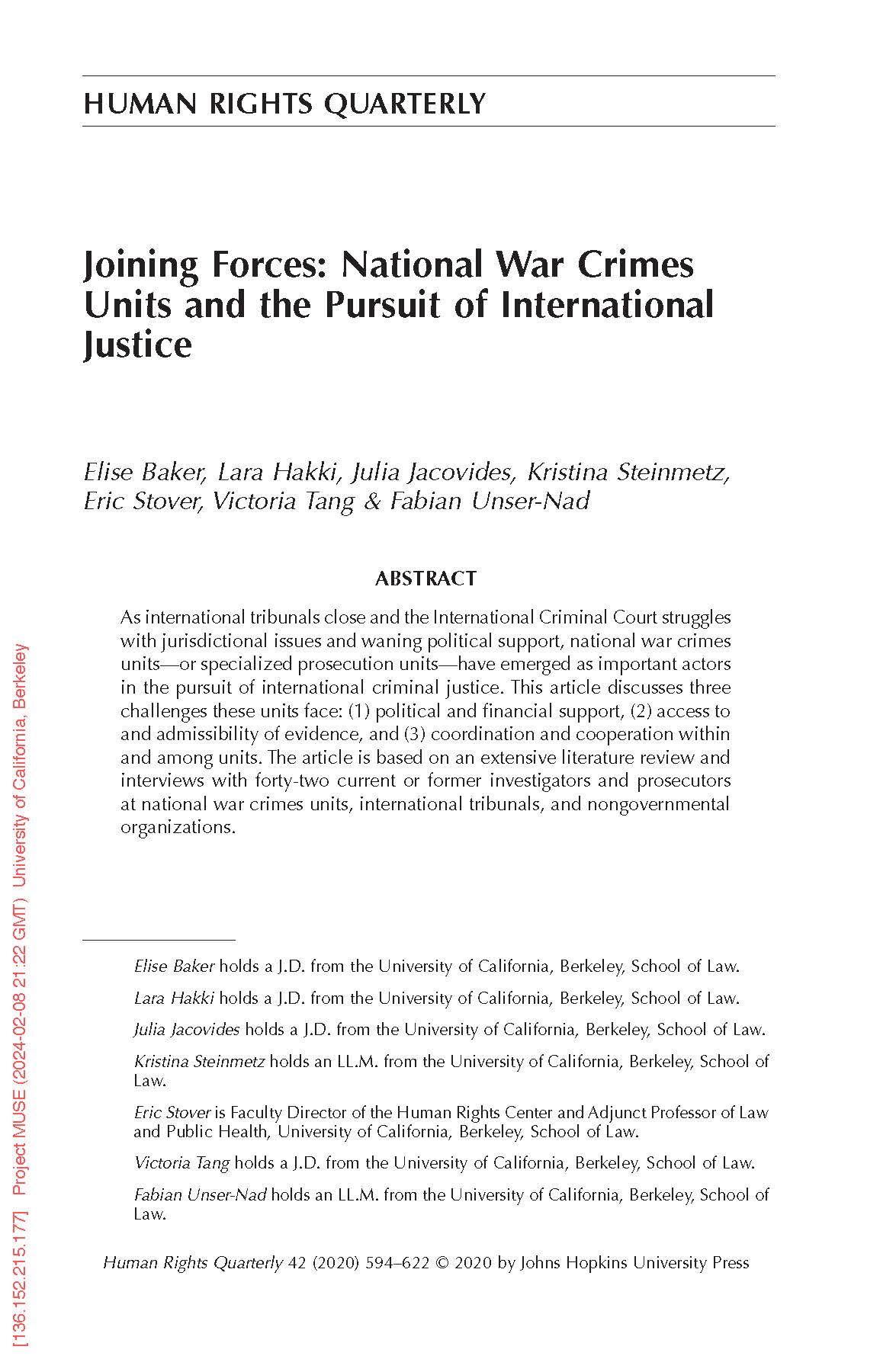
Joining Forces: National War Crimes Units and the Pursuit of International Justice
Publication Date
August 19, 2020
Publication Type
Journal Article
Topic(s)
Conflict, International Criminal Law, International Humanitarian Law
Summary
As international tribunals close and the International Criminal Court struggles with jurisdictional issues and waning political support, national war crimes units — or specialized prosecution units — have emerged as important actors in the pursuit of international criminal justice. This article discusses three challenges these units face: (1) political and financial support, (2) access to and admissibility of evidence, and (3) coordination and cooperation within and among units. The article is based on an extensive literature review and interviews with forty-two current or former investigators and prosecutors at national war crimes units, international tribunals, and nongovernmental organizations.
Key Takeaways
- National war crimes units have emerged as crucial players in pursuing international criminal justice as international tribunals close and the ICC faces jurisdictional challenges. These units encounter major obstacles such as securing political and financial backing, accessing and handling evidence, and ensuring coordination among different agencies and countries.
- The effectiveness of national war crimes units often depends on their ability to leverage universal jurisdiction, allowing them to prosecute individuals for serious international crimes irrespective of where the crime took place. Some countries, like those in Europe and North America, have taken significant steps in this direction, using immigration laws to prosecute crimes when direct charges are not feasible.
- Evidence collection is a significant challenge, especially witness testimony which can be fraught with inconsistencies and the risks of re-traumatization. Innovations such as open source investigations using digital and social media platforms have become influential, although they bring their own sets of challenges regarding verification and admissibility in court.
- There is a strong emphasis on improving cooperation and information sharing between national war crimes units, NGOs, and international bodies. Formal agreements and informal networks play a critical role in coordinating international efforts, as seen in successful models like the Eurojust Genocide Network and the IIIM.
- Financial and logistical constraints remain persistent issues, with units needing to justify the allocation of resources to pursue justice for international crimes. Public education and awareness campaigns can play a vital role in building support for these efforts.
- The article highlights that the fight against impunity involves various actors including national units, NGOs, and international tribunals, each contributing valuable resources and perspectives. Despite numerous challenges, the field of international criminal justice continues to adapt and find new ways to hold perpetrators accountable.
Suggested Citation
Baker, E., Hakki, L., Jacovides, J., Steinmetz, K., Stover, E., Tang, V., & Unser-Nad, F. (2020)
Joining Forces: National War Crimes Units and the Pursuit of International Justice.
Human Rights Center, UC Berkeley. https://humanrights.berkeley.edu/publications/joining-forces-national-war-crimes-units-and-the-pursuit-of-international-justice/