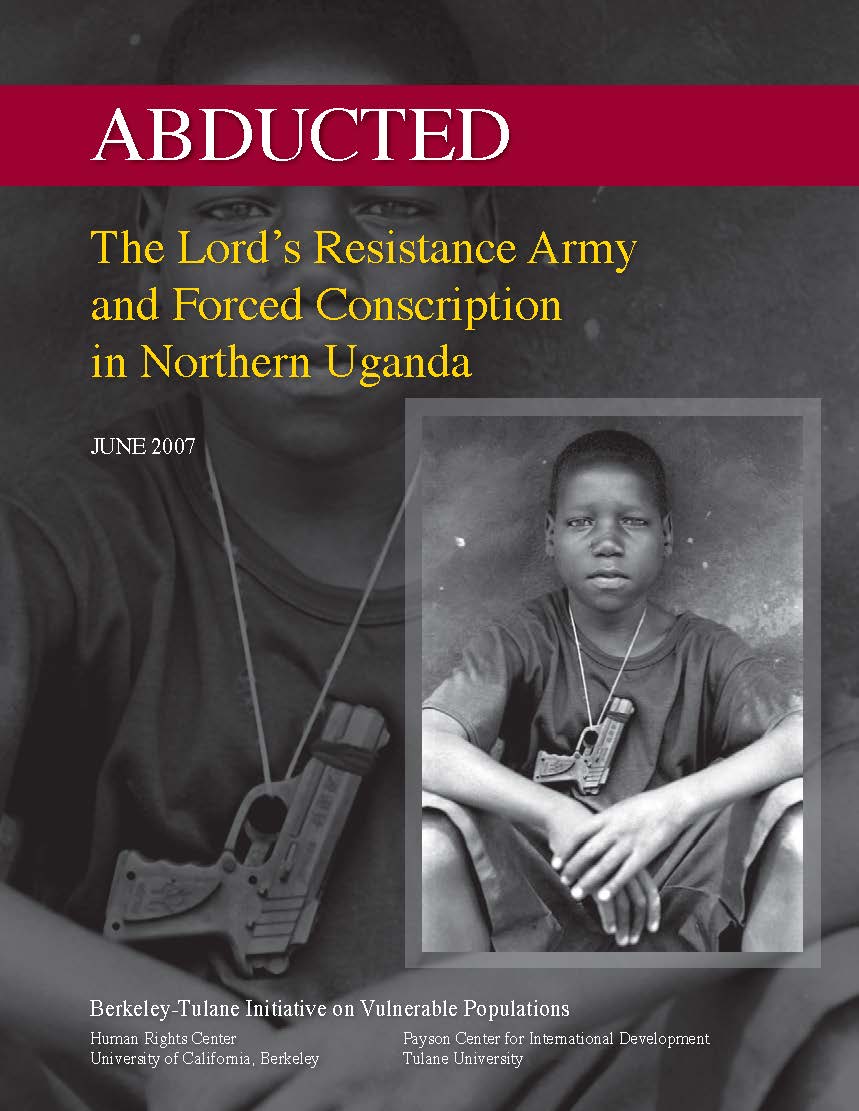
Abducted: The Lord’s Resistance Army and Forced Conscription in Northern Uganda
Publication Date
June 1, 2007
Publication Type
Report
Topic(s)
Conflict
Summary
Since the late 1980s, the Lord’s Resistance Army (LRA), a spiritualist rebel group with no clear political agenda, has abducted tens of thousands of children and adults to serve as porters and soldiers. In the early 1990s, children who escaped from the LRA or were captured by Ugandan soldiers were often paraded in the streets in the hope that someone would identify them. This treatment prompted a group of parents of abducted children to establish the Gulu Support the Children Organization (GUSCO), a reception center in Gulu, in 1994. In December 2005, the Berkeley-Tulane Initiative on Vulnerable Populations launched The Database Project to better document abduction and help improve the capacity of 8 reception centers in the northern districts of Gulu, Kitgum, Pader, Apac, and Lira to collect and analyze information about former LRA abductees.
Key Takeaways
- The Lord’s Resistance Army (LRA) in Northern Uganda has abducted a significant number of children and adults since the late 1980s, with estimated figures between 24,000 to 38,000 children and 28,000 to 37,000 adults. The majority of these abductions remain unaccounted for, as many abductees have either died or returned without being registered.
- Reception centers such as GUSCO, Caritas, and World Vision provide essential rehabilitation and reintegration services to former abductees. These centers offer programs that include vocational training, psychological counseling, and efforts to reunite children with their families. Data on formerly abducted individuals show varying lengths of captivity, with females typically held longer than males due to their roles as domestic and sexual servants.
- The experience of violence among LRA abductees is severe, including being forced to commit violence, exposure to torture, and in some cases being given to commanders as ‘wives.’ The LRA uses abduction as a tactic to recruit fighters and instill fear, and the Ugandan military’s efforts to curb these activities have been insufficient.
- Improving data management and creating standardized systems for documenting abductions are crucial. This allows for better identification of patterns, assists in the reunification of abductees with their families, and enhances the overall effectiveness of reintegration programs. The international community plays a role in these efforts to protect and support vulnerable northern Ugandan populations.
- Despite peace efforts leading to decreased hostilities, the potential for resurgence remains if conflict re-escalates. Preparation and resources remain crucial to support new surges of returnees should peace interventions fail or when peace agreements are reached, leading to further demobilization of the LRA’s ranks.
- The report underscores the importance of community-based and integrated programs in addressing the needs of all war-affected children and youth, not just former abductees. Programs should focus on providing comprehensive educational and vocational opportunities and addressing the broader impact of generalized violence in Northern Uganda.
Suggested Citation
Pham, P., Vinck, P., & Stover, E. (2007)
Abducted: The Lord’s Resistance Army and Forced Conscription in Northern Uganda.
Human Rights Center, UC Berkeley. https://humanrights.berkeley.edu/publications/abducted-lords-resistance-army-and-forced-conscription-northern-uganda-0/