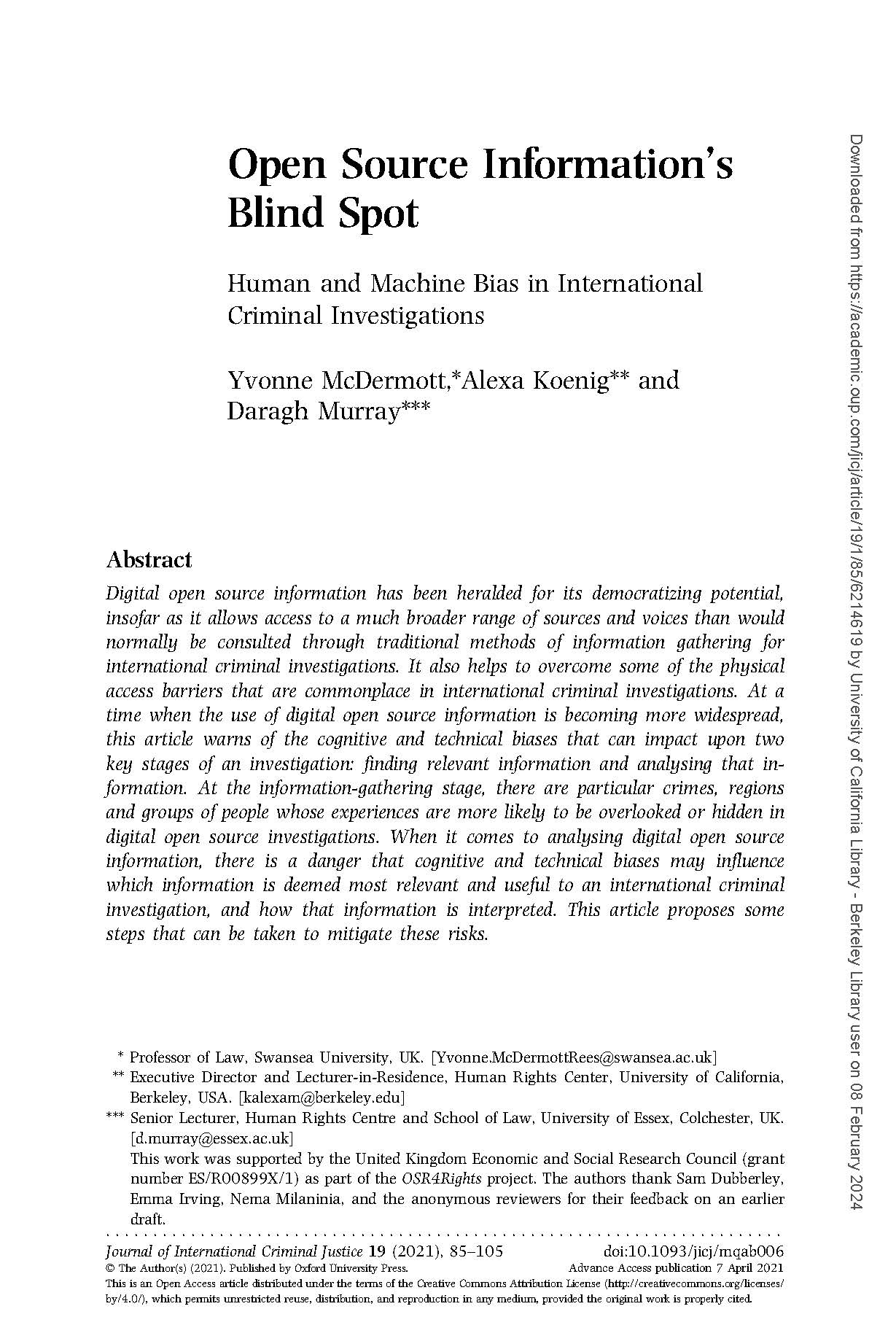
Open Source Information’s Blind Spot: Human and Machine Bias in International Criminal Investigations
Publication Date
April 7, 2021
Publication Type
Journal Article
Topic(s)
International Criminal Law, Investigations Program, Open Source Investigations, Technology
Summary
Digital open source information has been heralded for its democratizing potential, insofar as it allows access to a much broader range of sources and voices than would normally be consulted through traditional methods of information gathering for international criminal investigations. It also helps to overcome some of the physical access barriers that are commonplace in international criminal investigations. At a time when the use of digital open source information is becoming more widespread, this article warns of the cognitive and technical biases that can impact upon two key stages of an investigation: finding relevant information and analysing that information. At the information-gathering stage, there are particular crimes, regions and groups of people whose experiences are more likely to be overlooked or hidden in digital open source investigations. When it comes to analysing digital open source information, there is a danger that cognitive and technical biases may influence which information is deemed most relevant and useful to an international criminal investigation, and how that information is interpreted. This article proposes some steps that can be taken to mitigate these risks.
Key Takeaways
- Digital open source information has the potential to democratize international criminal investigations by providing access to a broader range of sources and voices, overcoming physical access barriers, and potentially offering more objective evidence than human witnesses.
- The use of digital open source information in investigations is fraught with cognitive and technical biases that can affect both the gathering and analysis of information, leading to systematic errors or oversights in investigations.
- Technical biases include issues like access bias, where certain groups may be underrepresented online, and algorithmic and machine biases, which can influence search results or the interpretation of data due to inherent biases in training data.
- Cognitive biases such as anchoring, confirmation bias, and the availability heuristic can distort how investigators perceive and prioritize information during investigations, potentially leading to skewed results.
- Despite open source information’s potential to enhance investigations, it cannot replace the need for witness testimony, particularly those of ‘insider’ witnesses, to establish culpability and contextualize evidence.
- To mitigate biases, investigators are advised to incorporate diverse perspectives, engage in rigorous verification processes, and use complementary investigative methods alongside open source techniques.
Suggested Citation
McDermott, Y., Koenig, A., & Murray, D. (2021)
Open Source Information’s Blind Spot: Human and Machine Bias in International Criminal Investigations.
Human Rights Center, UC Berkeley. https://humanrights.berkeley.edu/publications/open-source-informations-blind-spot-human-and-machine-bias-in-international-criminal-investigations/