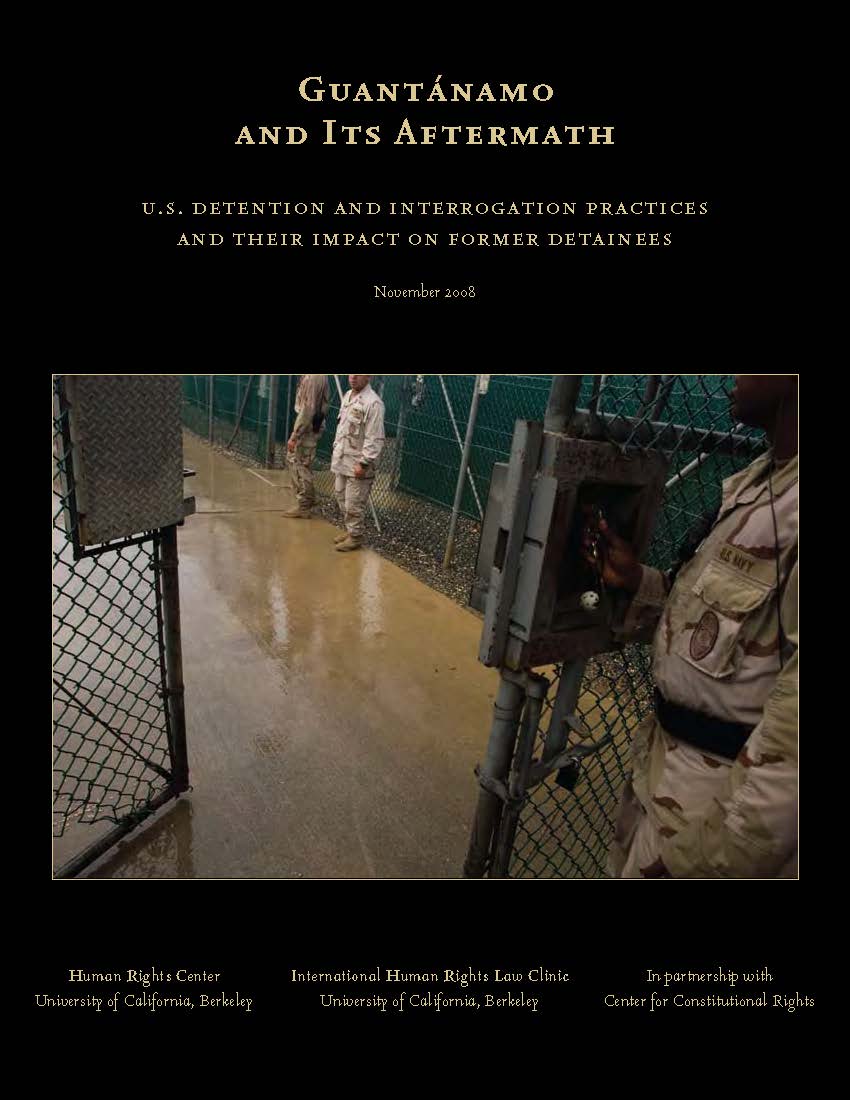
Guantánamo and Its Aftermath: U.S. Detention and Interrogation Practices and Their Impact on Former Detainees
Publication Date
November 1, 2008
Publication Type
Report
Topic(s)
Conflict, International Criminal Law, Investigations Program
Summary
This report provides the findings of a study of former detainees who were held in U.S. custody in Afghanistan and Guantánamo Bay, Cuba. The primary objective of the study was to record the experiences of these men, assess their treatment in detention, and explore how the conditions of their incarceration affected their subsequent reintegration with their families and communities. Our research reveals serious flaws in the system created by the Bush Administration for the apprehension, detention, interrogation, and release of suspected members of the Taliban and Al Qaeda taken into U.S. custody since the attacks on September 11, 2001. This report was completed in partnership with the Human Rights Law Clinic (Berkeley Law), and the Center for Constitutional Rights. Contributors: Stephen Paul Smith, Alexa Koenig, Zulaikha Aziz, Alexis Kelly, Sarah Staveteig, and Nobuko Mizoguchi.
Key Takeaways
- The report highlights serious systemic flaws in the U.S. detention and interrogation processes at facilities like Guantánamo Bay, which included the use of ‘enhanced interrogation techniques’ that likely violated international prohibitions against torture and inhumane treatment.
- Many detainees at Guantánamo were reportedly held without meaningful evidence of terrorism connections, with high-ranking officials aware that a significant fraction of detainees did not pose a security threat.
- Upon release, former detainees often faced stigma and a lack of support, complicating their reintegration into society. They experienced issues such as economic hardship, familial estrangement, and mental health challenges without U.S. acknowledgment of the impact of their wrongful detention.
- The report recommends establishing an independent commission with subpoena power to fully investigate U.S. detention practices, accountability for abuses, and measures for the rehabilitation and reintegration of former detainees.
Suggested Citation
Fletcher, L., & Stover, E. (2008)
Guantánamo and Its Aftermath: U.S. Detention and Interrogation Practices and Their Impact on Former Detainees.
Human Rights Center, UC Berkeley. https://humanrights.berkeley.edu/publications/guantanamo-and-its-aftermath-us-detention-and-interrogation-practices-and-their-impact/