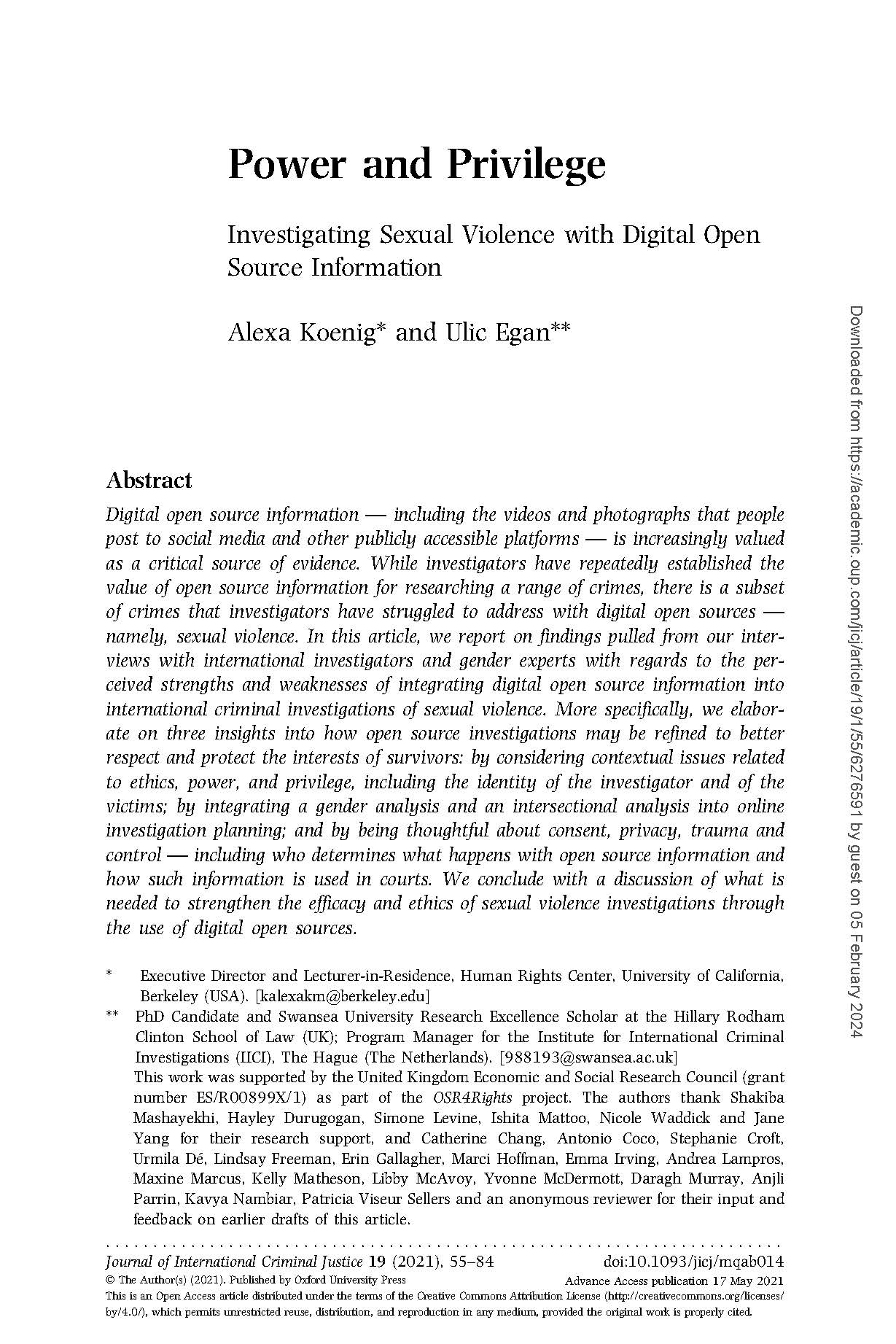
Power and Privilege: Investigating Sexual Violence with Digital Open Source Information
Publication Date
May 17, 2021
Publication Type
Report
Topic(s)
Conflict, Investigations Program, Open Source Investigations, Technology
Summary
Digital open source information is increasingly valued as a critical source of evidence. While investigators have repeatedly established the value of open source information for researching a range of crimes, there is a subset of crimes that investigators have struggled to address with digital open sources — namely, sexual violence. In this article, we report on findings pulled from our interviews with international investigators and gender experts with regards to the perceived strengths and weaknesses of integrating digital open source information into international criminal investigations of sexual violence. More specifically, we elaborate on three insights into how open source investigations may be refined to better respect and protect the interests of survivors: by considering contextual issues related to ethics, power, and privilege, including the identity of the investigator and of the victims; by integrating a gender analysis and an intersectional analysis into online investigation planning; and by being thoughtful about consent, privacy, trauma and control — including who determines what happens with open source information and how such information is used in courts. We conclude with a discussion of what is needed to strengthen the efficacy and ethics of sexual violence investigations through the use of digital open sources.
Key Takeaways
- Digital open source information is valuable for gathering evidence in international criminal investigations, including cases of sexual violence. However, specific challenges such as ethical concerns, gendered access, and cultural stigmas pose obstacles to its effective use.
- The integration of a gender and intersectional analysis into digital investigations is essential. This involves examining power dynamics, understanding gender roles, and considering how different identities may affect access to technology and platforms.
- Ethical considerations are critical in digital investigations of sexual violence. Investigators must address issues like consent, privacy, and the trauma experienced by survivors, and ensure that digital materials are collected and used responsibly.
- Cross-disciplinary collaboration, including partnerships with local civil society and gender experts, is necessary to ensure that investigations are ethical and comprehensive, respecting the dignity and agency of survivors.
- The effective use of digital tools calls for creativity and a nuanced understanding of the digital landscape, such as knowing when and where to search for information beyond common platforms and being aware of ‘invisible’ information affected by cultural and structural barriers.
- There is a growing concern about potential reliance on digital evidence overshadowing testimonies in court, which could undermine traditional witness testimonies and thus affect the pursuit of justice, particularly in sexual violence cases.
Suggested Citation
Koenig, A., & Egan, U. (2021)
Power and Privilege: Investigating Sexual Violence with Digital Open Source Information.
Human Rights Center, UC Berkeley. https://humanrights.berkeley.edu/publications/power-and-privilege-investigating-sexual-violence-with-digital-open-source-information/