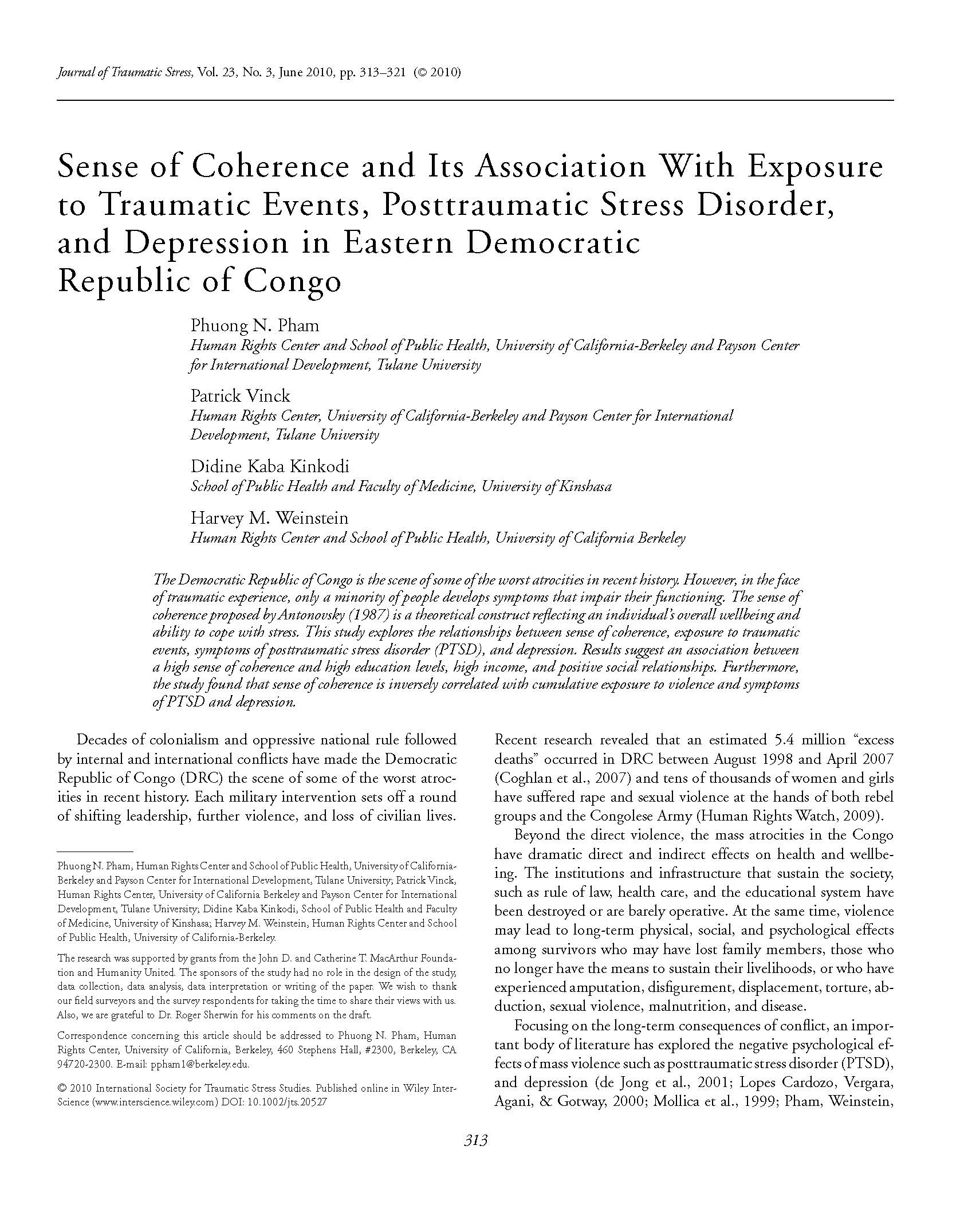
Sense of Coherence and Its Association with Exposure to Traumatic Events, Posttraumatic Stress Disorder, and Depression in Eastern Democratic Republic of Congo
Publication Date
June 1, 2010
Publication Type
Journal Article
Topic(s)
Conflict, Public Health
Summary
The Democratic Republic of Congo is the scene of some of the worst atrocities in recent history. However, in the face of traumatic experience, only a minority of people develops symptoms that impair their functioning. The sense of coherence proposed by Antonovsky (1987) is a theoretical construct reflecting an individual’s overall wellbeing and ability to cope with stress. This study explores the relationships between sense of coherence, exposure to traumatic events, symptoms of posttraumatic stress disorder (PTSD), and depression. Results suggest an association between a high sense of coherence and high education levels, high income, and positive social relationships. Furthermore, the study found that sense of coherence is inversely correlated with cumulative exposure to violence and symptoms of PTSD and depression.
Key Takeaways
- The study examines the relationship between sense of coherence and exposure to traumatic events, PTSD, and depression among residents of eastern Democratic Republic of Congo, highlighting the importance of sense of coherence in coping with stress and maintaining well-being despite exposure to violence.
- High sense of coherence is positively associated with higher education, higher income, and positive social relationships, while inversely correlated with exposure to violence and symptoms of PTSD and depression, suggesting socioeconomic status and social networks play a role in psychological resilience.
- The survey conducted involved 2,635 adults from conflict-affected provinces, employing multistage cluster random sampling. This comprehensive approach ensured a diverse sample, inclusive of multiple ethnic groups and genders, although exposure to violence was notably high across the sample.
- The sense of coherence construct, based on Antonovsky’s theory, serves as a key tool in understanding how individuals might maintain health and well-being despite traumatic circumstances, emphasizing the need for interventions that enhance comprehensibility, manageability, and meaningfulness of individuals’ environments.
- Despite pervasive conflict, many individuals did not develop PTSD or depression, pointing towards an intrinsic resilience that could be bolstered through targeted public health interventions, fostering social cohesion and addressing socio-economic disparities to improve health outcomes.
- The study underlines the need for further research into the protective factors of sense of coherence and its impact on mental health outcomes, aiming to inform public health strategies and psychosocial interventions in conflict zones.
Suggested Citation
Pham, P., Vinck, P., Weinstein, H., & Kinkodi, D. (2010)
Sense of Coherence and Its Association with Exposure to Traumatic Events, Posttraumatic Stress Disorder, and Depression in Eastern Democratic Republic of Congo.
Human Rights Center, UC Berkeley. https://humanrights.berkeley.edu/publications/sense-coherence-and-its-association-exposure-traumatic-events-posttraumatic-stress/