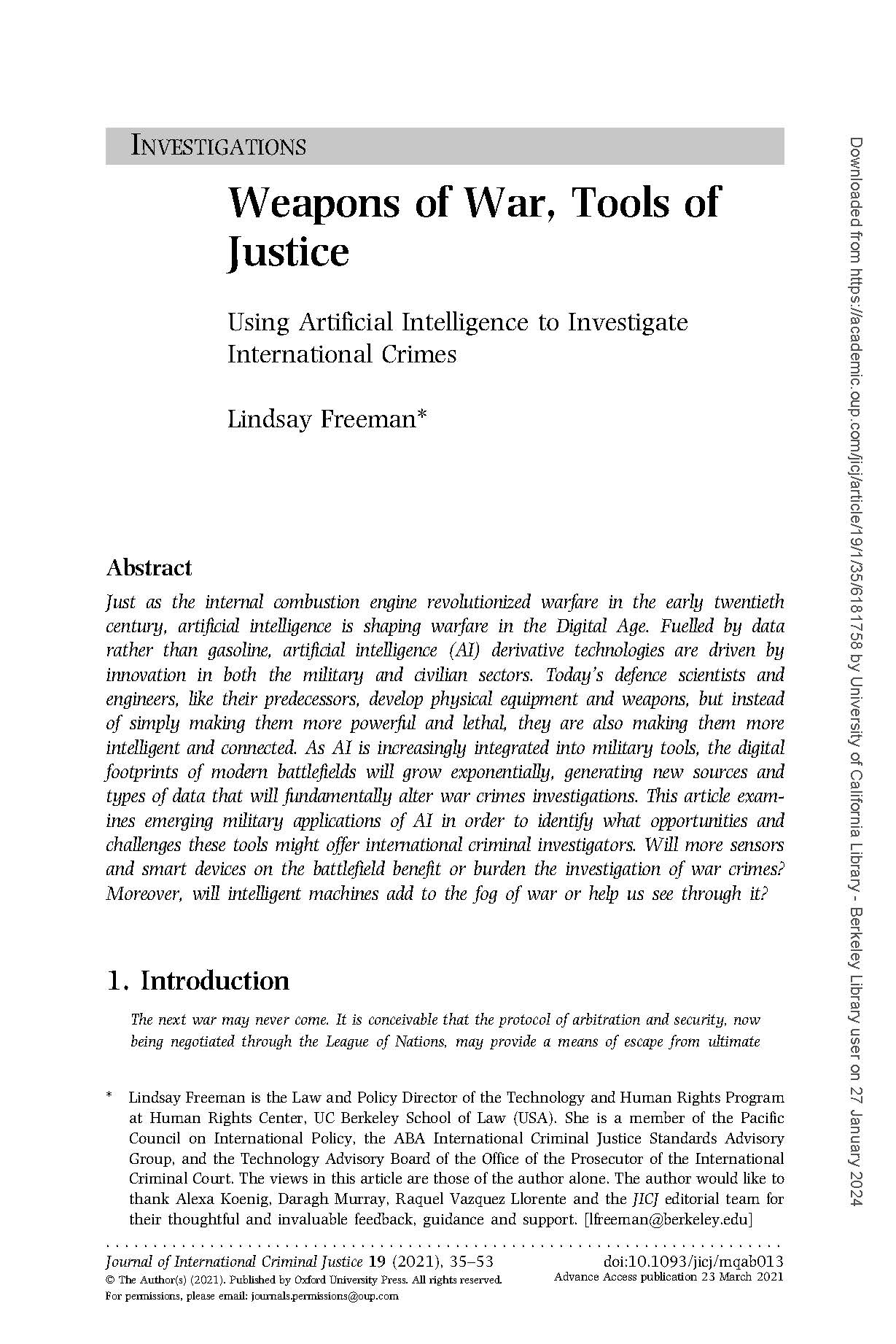
Weapons of War, Tools of Justice: Using Artificial Intelligence to Investigate International Crimes
Publication Date
March 23, 2021
Publication Type
Book Chapter
Topic(s)
International Criminal Law, International Humanitarian Law, Technology
Summary
Just as the internal combustion engine revolutionized warfare in the early twentieth century, artificial intelligence is shaping warfare in the Digital Age. Fuelled by data rather than gasoline, artificial intelligence (AI) derivative technologies are driven by innovation in both the military and civilian sectors. Today’s defence scientists and engineers, like their predecessors, develop physical equipment and weapons, but instead of simply making them more powerful and lethal, they are also making them more intelligent and connected. As AI is increasingly integrated into military tools, the digital footprints of modern battlefields will grow exponentially, generating new sources and types of data that will fundamentally alter war crimes investigations. This article examines emerging military applications of AI in order to identify what opportunities and challenges these tools might offer international criminal investigators. Will more sensors and smart devices on the battlefield benefit or burden the investigation of war crimes? Moreover, will intelligent machines add to the fog of war or help us see through it?
Key Takeaways
- Artificial Intelligence (AI) is being increasingly integrated into military tools, creating new data sources that could transform war crimes investigations. The digital footprints created by these technologies may both assist and challenge international criminal investigators.
- AI technologies offer dual-use potential in warfare: they can both enhance intelligence and facilitate deception. For instance, the use of Generative Adversarial Networks (GANs) in military applications can improve both detection and generation of synthetic images, demonstrating AI’s paradoxical role as both a tool for truth and obfuscation.
- The Internet of Military Things (IoMT) represents a shift towards interconnected devices in military contexts, which could improve situational awareness and operational intelligence. However, this also raises concerns about data integrity and the potential for data manipulation in war crimes investigations.
- War crimes investigators face significant challenges in utilizing data produced by military AI technologies, especially in terms of aggregating, analyzing, and ensuring the authenticity of such data. Emerging digital manipulation tools, like deepfakes, further complicate the reliability of digital evidence.
- International criminal justice entities need to prepare for technical challenges posed by AI and other digital technologies in warfare by improving technological infrastructure, investing in AI literacy among personnel, adopting AI for evidence analysis, and creating partnerships with tech companies.
- AI can enhance transparency and accountability by supporting international criminal investigations, but it also imposes new challenges. Investigators must navigate these by developing standards and workflows capable of handling and verifying digital evidence amidst the complexities of modern warfare.
Suggested Citation
Freeman, L. (2021)
Weapons of War, Tools of Justice: Using Artificial Intelligence to Investigate International Crimes.
Human Rights Center, UC Berkeley. https://humanrights.berkeley.edu/publications/weapons-of-war-tools-of-justice-using-artificial-intelligence-to-investigate-international-crimes/